How the system works

Most mail operations measure response rate. We measure whether the people we mailed actually sold.

We pull courthouse signals weekly in every US county. The Kansas City numbers below are illustrative for a typical 5-county footprint — your county's percentages will look slightly different, but the system is the same. This page is written for the direct mail customer — it's what we do best.

The pie is smaller than you think.

Out of every 200,000 properties, ~1,000 actually sell.

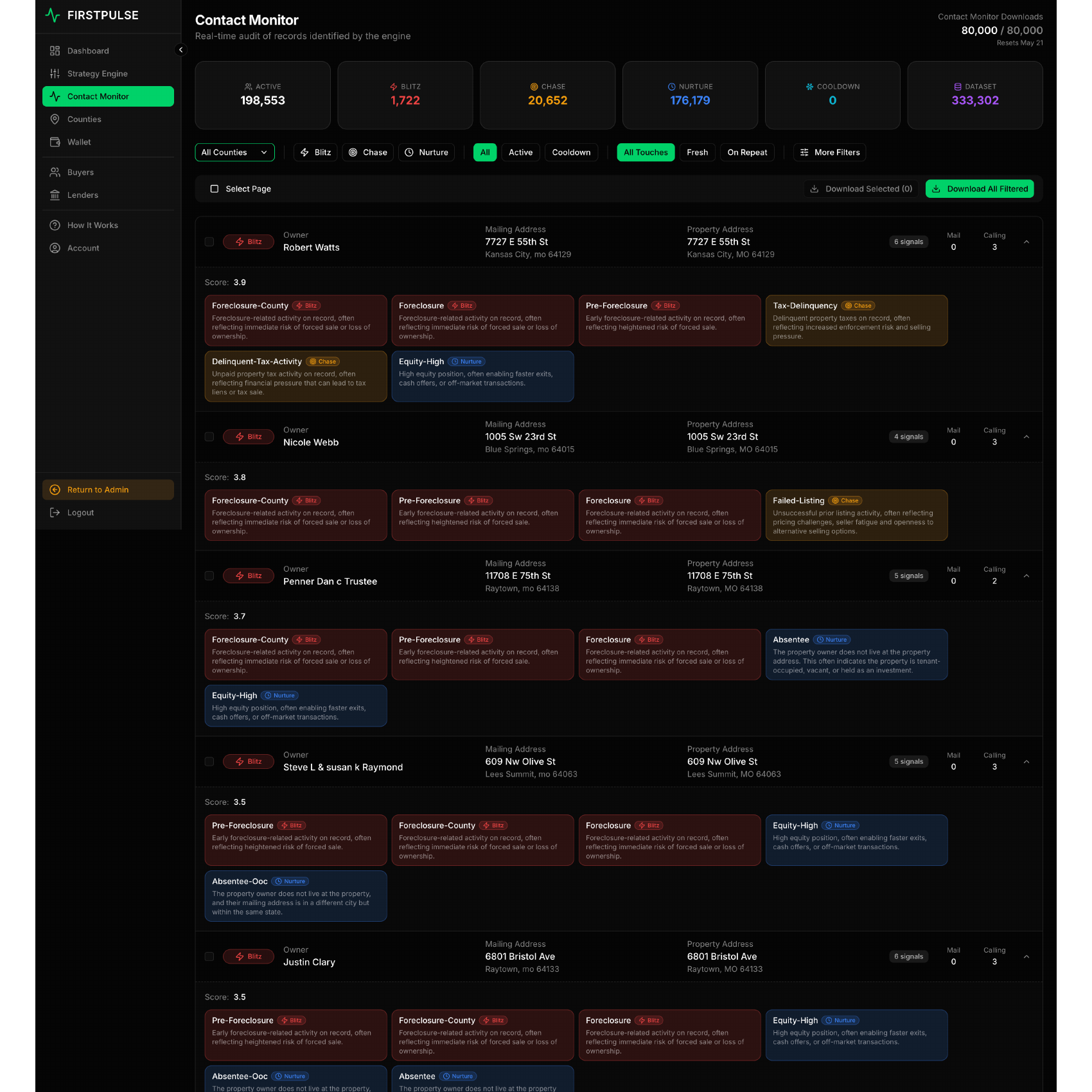
Take Kansas City. Across the 5 counties we cover, there are 1.7 million people in 654,402 properties. We narrow that two ways: your buy box (single-family, reasonable price band, owner-occupied or absentee), and a 0.25 score floor — below that the chance of a sale is so small that mail or skip-trace isn't economical. 198,553 properties make both cuts.

1,703,222
people
654,402
total properties
198,553
worth contacting (buy box · score > 0.25)
~80
sell to an investor each week

These numbers come from your live FirstPulse Counties dashboard. Every operator we serve sees their own version updated weekly.

Mail every one of those 198,553 each week and you're paying for ~198,500 contacts to catch ~80 actual sales — spending 99.96% of your budget on people who won't sell this week. The job isn't reaching everyone. The job is finding which ~80 are most likely to sell and respond, before another investor does.

Of those weekly sales

Here's where they came from.

The bars below split the eligible pool by lane, then split the actual investor sales by lane. The mismatch is the whole story.

Of every 100 homeowners in a typical buy box…
0.7%
8.4%
90.9%
Blitz 0.7%
Chase 8.4%
Nurture 90.9%
…this is who actually sold to an investor.
18%
36%
46%
Blitz 18.2%
Chase 35.5%
Nurture 46.3%
Step zero

Before the system can work, the data has to be fresh.

Most data companies license county records from First American with a delay — averages about 14 days, can be 60+ days in some counties. By the time you mail, the homeowner is already weeks past whatever signal triggered the list.

We've built scrapers across 3,000+ counties and pull weekly directly from each county's recorder. When a signal fires in your county, it's in your weekly list — not someone else's three weeks later.

Beyond the obvious waste

Where your mail budget actually leaks.

The 99.96% waste from mailing non-sellers is the obvious one. There are five more leaks most operators never plug:

Each leak is small. Together they're 20–40% of a typical DIY operator's mail budget gone, no questions asked.

What we figure out

The right contact. At the right time. (And the right message.) The right contact. At the right time. The right contact. At the right time. The right contact. At the right time.

Three problems, all hard, all equal. Get one wrong and you've burned a deal. We work all three. Two problems, both hard, both equal. Get one wrong and you've burned a deal. We work both. Two problems, both hard, both equal. Get one wrong and you've burned a deal. We solve who and when — you handle the message. Two problems, both hard, both equal. The list tells you who and when — your door does the rest.

01
WHO

Score and rank every contact in your buy box.

Pre-foreclosure filings, probate cases, tax delinquency, vacancy, owner age, equity, length of ownership, absentee status. Each contact carries a score calibrated against historical investor sales — a weight that reflects how well that signal predicted real recorded transactions in your county.

Everyone in your buy box gets a score. We sort the list top to bottom. We mail down the list until your weekly volume is filled. The people below the line stay eligible — and move up the moment they pick up a new signal.

The output is a ranked list of who's most likely to sell.

02
WHEN

Pick the right rhythm for each kind of seller.

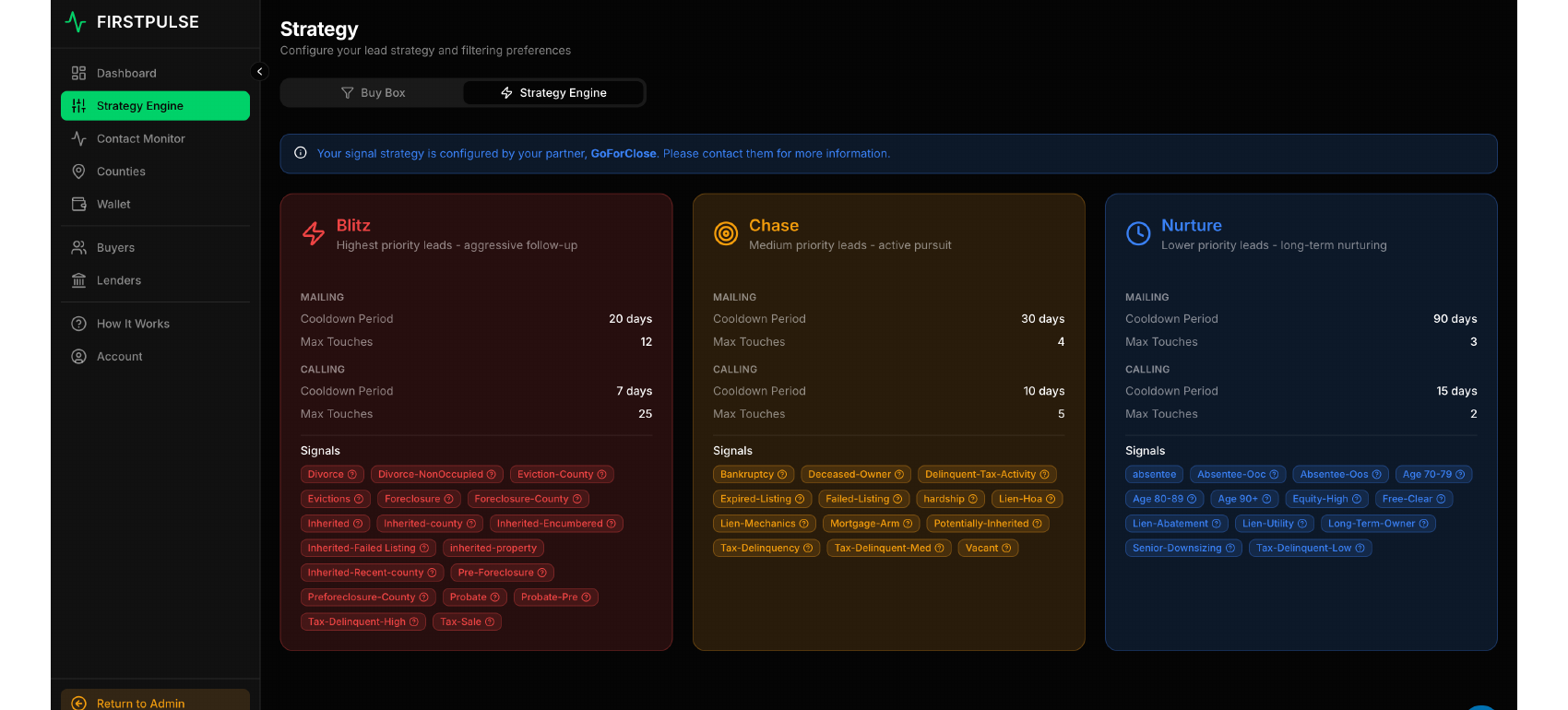
A pre-foreclosure has weeks. A senior absentee owner has years. Hammering the senior weekly burns the relationship; calling the pre-foreclosure once a month misses the window entirely. Different rhythms for different kinds of urgency — that's what lanes are.

The output is a cadence: Blitz, Chase, or Nurture.

03
WHAT

Test the message that lifts response.

Same list, different mail piece — different response rates. Every week, 10% of your mail budget runs as a controlled A/B test against the main piece. Different copy, different formats. What lifts response rolls into next week's main run. What doesn't gets pulled.

Audiences and counties drift, so the testing never stops.

The output is mail that keeps getting sharper.

How you actually use this

Done-for-you direct mail. Your only job is volume. Three lane-separated files. Loaded into your dialer. Mail and call the same scored list. We keep them in sync. Just the data. You execute. Same list, on foot. Focused radius, focused effort.

What you receive. Every week, a ranked list — top of pool, lane-aware — handed off to your mail house ready to print. A monthly lift report against your actual recorded sales.

What you do. Tell us your monthly volume. Review the lift report. Approve creative when we surface a test winner. That's it.

What we do. Score the list, manage the cadence (14/30/45-day cool-downs by lane), test 10% of your budget against new copy each week, swap winners into the main run.

County-level protection: we limit active accounts per county so we're not generating motivated seller leads for your direct competitors. Available counties are limited — once your county is locked, it's yours.

What you receive. Three weekly files dropped into your dialer — Blitz, Chase, Nurture — already lane-separated and score-ranked within each lane. Brand-new contacts only.

What you do. Configure three campaigns in your dialer with different cadences, different cool-downs, different scripts. Dial through your weekly capacity.

What we do. Find and rank the contacts. Cross-reference against your previous deliveries so you never call the same person twice through us. Your dialer handles the recycling.

County-level protection: we limit active accounts per county so we're not generating motivated seller leads for your direct competitors. Available counties are limited — once your county is locked, it's yours.

What you receive. Same scored list, two channels. Weekly mail delivery to your mail house, plus three lane-separated call files to your dialer. Both run off the same ranking.

What you do. Set your mail volume. Set your dial capacity. Run both — we won't double-touch in the same week.

What we do. Score the list once. Route the top to mail, deliver fresh call contacts in lane order. Manage mail cadence on our side, lane your call files for your dialer to handle on its.

County-level protection: we limit active accounts per county so we're not generating motivated seller leads for your direct competitors. Available counties are limited — once your county is locked, it's yours.

What you receive. The same weekly scored, lane-separated lists we deliver to our full-stack clients. $298/mo subscription.

What you do. Execute however you want — print your own mail, dial it yourself, knock the doors, send texts. You handle everything downstream of the list.

What we do. Build the list. Same scoring, same signals, same lane logic. Realistic outcome on a focused county with disciplined effort: a deal a month.

County-level protection: we limit active accounts per county so we're not generating motivated seller leads for your direct competitors. Available counties are limited — once your county is locked, it's yours.

What you receive. The same weekly scored list — focused on a tight ZIP radius you can actually cover on foot. We help you pick the right radius and the right tier.

What you do. Door-knock the top of the list. Show up in person, do the work. No mail, no calls.

What we do. Build the list. Blitz signals are best for door-knocking — court dates and time-sensitive distress are hard to ignore at the door. We surface those first.

County-level protection: we limit active accounts per county so we're not generating motivated seller leads for your direct competitors. Available counties are limited — once your county is locked, it's yours.

You set the volume. We make sure every contact you reach is the right one, in the right rhythm, with a message we're constantly improving.

Proof
Lift.
How we know our scoring is working.

Scoring tells us who to put at the top of your list. Lift tells us whether the people at the top actually sold more often than the people at the bottom. We compare our list against random mailings of the same size in the same county. 2× lift means twice as good as random. 1× lift means no better. If lift drops, our scoring needs work — that's the only honest scorecard.

More mail isn't more deals.

Why your weekly list stops at the elbow — in one curve.

  • Mailing at random
  • Our ranked list
  • The gap = your advantage
  • The elbow — where your list stops

Mail too little and you miss the train. Mail too much and you pay postage for near-zero-probability sellers. The job is finding the elbow — and our weekly list is built around it.

Lift across 5 Kansas City–area counties
County Investor sales
in window
We tagged
before sale
Coverage Lift
Jackson, MO
4977739.4%2.83×
Johnson, KS
2184649.1%2.24×
Clay, MO
913562.6%1.95×
Platte, MO
311861.3%1.79×
Wyandotte, KS
1185564.4%1.51×
Across all five counties · 955 investor sales · 231 tagged before saleavg 2.06×
Jackson, MO
2.83×
Sales
497
Tagged
77
Coverage
39.4%
Johnson, KS
2.24×
Sales
218
Tagged
46
Coverage
49.1%
Clay, MO
1.95×
Sales
91
Tagged
35
Coverage
62.6%
Platte, MO
1.79×
Sales
31
Tagged
18
Coverage
61.3%
Wyandotte, KS
1.51×
Sales
118
Tagged
55
Coverage
64.4%

Window: Jan 21 – Apr 13, 2026 · Recorded deeds · Every one is verifiable. If you want to pull a county yourself, ask.

Your first 7 days

From signup to mail in mailboxes — 7 days.

No long onboarding. No waiting weeks for a "strategy session." Your market analysis starts immediately, your data engine activates within days, and your first campaign drops within a week.

  1. 01

    Market Analysis

    Days 1–3

    We study your county — competition density, converting distress types in your ZIP codes, effective mail formats — and build your custom strategy.

  2. 02

    Data Engine Activates

    Days 3–5

    FirstPulse pulls fresh courthouse data, scores every contact with PulseScore, and stacks 4–6+ distress indicators across your buy box.

  3. 03

    Campaign Architecture

    Days 4–6

    We select mail pieces based on what's converting in your market, configure cadences, purchase tracking phone numbers, and prep weekly fresh ingestion.

  4. 04

    First Mail Drops

    Day 7

    Printing, postage, delivery — all handled. Seven days from your onboarding call to mail in mailboxes. Guaranteed.

If we don't hit 7 days, we'll make it right.

The question you're about to ask

What should I budget? And what will I get back?

Two honest answers. The first one disqualifies some readers — that's intentional.

If you're under ~$1,500/mo

Mail probably isn't your channel — but the data still is.

Direct mail compounds with volume. Under roughly $1,500/month in mail spend, the math doesn't work — you're not mailing enough pieces, often enough, to overcome the slack in any given week's responders.

If that's where you are, the right path is Fresh at $298/mo with no mail budget: the same weekly scored, lane-separated lists our mail clients get, and you door-knock the top of the list or dial it yourself. Time-for-money instead of money-for-time. We have clients running this way successfully — realistic outcome on a focused county with disciplined door-knocking: a deal a month.

The pricing page math will tell you which path fits.

On targeted lists at our scoring quality, the planning ratio is roughly 1 deal per 3,000 pieces mailed — about a 0.5% response rate with 1 in 15 responses converting. That's the math we plan against, not a guarantee. Your county density, buy box width, and follow-up discipline all move the actual ratio. Pick a volume you can sustain for at least 90 days — that's when the cadence loops have compounded enough to read.

Entry volume
~5,000 pieces / mo
Mail budget ~$3,000/mo
Subscription $298/moFresh
Total ~$3,300/mo

Where most operators start IF they're testing or in a small market.

★ Most operators land here
~8,400 pieces / mo
Mail budget ~$5,000/mo
Subscription $698/moFocused
Total ~$5,700/mo

Sweet spot for 90-day compounding into deal flow.

High volume
~11,500 pieces / mo
Mail budget ~$6,900/mo
Subscription $1,498/moExpansion
Total ~$8,400/mo

For operators with the close-rate to feed it. 3 counties.

These are planning numbers. Your county's signal density, your buy box width, your follow-up discipline, and your conversion skill all move the actual ratio. We re-calibrate against your real results every quarter — month one isn't a verdict.

FAQ

Common questions.

Coverage is the percentage of investor sales we tagged before the sale. 39–64% on a small targeted list is the design goal — not a ceiling we're trying to break through.

If you wanted 100% coverage, you'd mail every distressed property in the county — 50,000+ pieces a month, most of them on properties no investor will ever buy. That's volume mailing.

We're built for the opposite: small focused list, most of the sellers caught anyway, fraction of the spend. Want bigger coverage? Same data, just scale the list up — the targeting still ranks them.

Each contact carries a PulseScore calculated from the signals we've captured for that property — pre-foreclosure filings, probate cases, tax delinquency, vacancy, owner age, equity position, length of ownership, absentee status, and several more.

The weights aren't guesses. They're calibrated against historical investor sales — every signal's weight reflects how well it predicted real recorded transactions.

We re-deliver them — to your Blitz file. The new signal warrants a different cadence and a different conversation, so the contact's whole treatment needs to change.

This is the only situation where the same contact appears in our delivery twice. Your dialer may briefly have them in two campaigns until the old entry ages out via cool-down. Intentional, not a duplicate.

Yes. Same data, same price, regardless of channel. You pay for the targeting; you decide how to reach the seller.

For SMS and RVM, the cold-call delivery model fits best (brand-new contacts, your platform recycles). For door-knocking, the mail-style cadence works (we manage cool-downs).

Ready to stop guessing and start closing?

See Pricing or grab the free Buyer Pack →
No setup fee·No management fee·No long-term contract·County exclusive
Your campaigns next week Lock in your county. Or try the free Buyer Pack.
See Pricing